
Gurgaon, 11 PM
On paper, this looked like a terrible idea.
Leave Gurgaon at 11 PM. Drive through the night. Reach Keylong the following evening. Cross Shinkula Pass, visit Phuktal Monastery, return to Gombok Rangan for the night, drive to Kasol the next day and somehow be back home within four days.
Fortunately, road trips are rarely judged on paper.

So, on the night of 27th May 2026, three friends loaded their bags into Sherpa, Gabru’s grey Hyundai Creta, and headed towards the Himalayas. The three friends were Gabru (Pramanshu Ranjan), Dr. Gaurav Arya from Bhopal and me. Sherpa and us already had some history. We had driven this very car to Chitkul and Kalpa a couple of years earlier, and somewhere during that journey the nickname had stuck. Since then, every mention of Sherpa brought back memories of mountain roads, roadside tea stalls and long friendly conversations.


The first few hours were exactly what road trips should be. Highway lights, toll plazas, late-night tea breaks and conversations that wandered wherever they pleased. We spoke about school days, mutual friends, previous trips and friends we had not met in years. Stories that had already been told multiple times somehow became entertaining once again. Somewhere during the night, the kilometres slipped by unnoticed. By the time dawn arrived, the plains were behind us and the first outlines of the mountains had begun appearing on the horizon.
The trip had officially started.
Through Kullu – Manali and into Lahaul
The drive through Kullu Valley felt familiar and comforting. The Beas River accompanied us for much of the day, alternating between being calm and furious depending on the shape of the valley. Pine forests climbed steep slopes, villages occupied impossible locations on mountainsides and tourists stopped every few kilometres to photograph scenery that locals probably ignored on a daily basis.
It was beautiful in the way Manali always is, but there was a feeling inside us that the journey had not really begun yet. This was familiar territory. The mountains we had come looking for lay beyond. The real transition happened at the Atal Tunnel.

Every time I cross the Atal Tunnel, it feels less like a road tunnel and more like a gateway between two different Himalayan worlds. On the Manali side, the mountains are wrapped in forests, villages appear every few kilometres and the roads are filled with tourists heading towards familiar destinations. A few minutes later, as we emerged towards Lahaul, the scenery changed almost instantly. The greenery began disappearing, the valleys widened dramatically and the mountains seemed to grow in both size and character. Bare rock replaced dense forests, rivers cut through vast open landscapes and entire mountain ranges stretched across the horizon without a single sign of human habitation. It felt as though the Himalayas had shed their softer side. They simply existed on their own terms—vast, rugged and impossible to ignore.

By the evening, we checked into Keylong hotel. The long drive was beginning to show on our faces, but so was the excitement. The mountains around the town seemed to rise straight out of the valley, their upper slopes still carrying patches of snow. As daylight faded, thoughts naturally turned towards the next day. Somewhere beyond those mountains lay Shinkula Pass and the road into Zanskar. The real adventure was about to begin.


The Road Beyond Darcha
The next morning, Sherpa rolled out of Keylong beneath clear blue skies and pointed itself towards Darcha. For much of the drive, the Bhaga River remained our constant companion. Mountain rivers have always fascinated me. Unlike rivers in the plains, they seem to carry a sense of urgency. The Bhaga crashed through rocks, squeezed through narrow valleys and hurled itself downhill with an energy that perfectly matched the landscape around it.
Beyond Darcha, as we took a left towards Shinkula, the Himalayas began revealing a different personality. Villages became fewer, traffic almost disappeared and mobile networks quietly gave up. The road climbed steadily into a landscape that felt increasingly wild and remote with every passing kilometre. Massive mountain walls rose directly from the valley floor, waterfalls appeared without warning and glacial streams crossed the road as though roads were merely a temporary inconvenience.


Every few kilometres, something compelled us to stop. Sometimes it was a waterfall plunging hundreds of feet down a cliff face. Sometimes it was a river carving its way through a valley far below. At other times, it was simply the scale of the mountains themselves. They seemed to grow larger with every bend, eventually becoming so immense that photographs struggled to capture what we were seeing.
As the altitude increased, the conversations inside Sherpa gradually faded. Nobody announced silence. It simply arrived on its own. Every now and then one of us would point towards a distant glacier, a snow-covered ridge or a waterfall hanging improbably from a mountainside, and the rest would immediately understand. The mountains had begun doing most of the talking. By now, Shinkula no longer felt like a destination marked on a map. It felt close. Somewhere beyond the next few valleys, hidden behind layers of mountains and snow, lay the pass we had spent weeks talking about. And with every kilometer we climbed, the anticipation grew.

Closing an Unfinished Loop
A little before Shinkula, we stopped at a place that would mean absolutely nothing to most travellers. There was no signboard, no viewpoint and nothing particularly remarkable about the location itself.
To us, however, it was far more than just another bend in the road.
Seven months earlier, my XUV500, Haathi, had stood at this very spot. We had been chasing the same destination, following the same road and carrying the same excitement. Then a coolant leak changed everything. The journey ended there. Shinkula remained beyond reach and we had no choice but to turn back.
The mountains had made the decision for us the last time.
This time, things were different.
Sherpa rolled to a halt at almost the exact location. Gabru stepped out and opened the bonnet. Not because there was anything wrong. There wasn’t. The engine was running perfectly. The bonnet was opened for a photograph, a quiet tribute to a vehicle that had brought me across thousands of kilometres over the years but had fallen short of this particular destination.


For a few moments, nobody was in a hurry.
We stood there, looking at Sherpa, looking at the road ahead and remembering another day when the story had ended differently.
Then the bonnet was closed.
The engine started.
And we drove on towards Shinkula.
Somewhere behind us, an unfinished chapter had finally found its ending.

Shinkula: The Wind, The Snow and The Silence
The final approach to Shinkula felt almost unreal. The road climbed steadily through a landscape that seemed to grow larger and more dramatic with every passing kilometre. Snow lined sections of the route, frozen streams cut across the terrain and mountains rose in every direction. There were moments when the road looked impossibly small against the vastness around it. Every bend revealed another view that made us slow down, another stretch of mountains that seemed too immense to fit into a photograph.
And then, suddenly, there was nowhere higher to drive.
We had reached Shinkula.

Sherpa rolled onto the top of the pass and came to a halt beside a landscape that seemed to stretch forever. Snow-covered ridges disappeared into the distance, mountains stood layered one behind another and the road we had spent hours climbing looked impossibly small below us.
For the next several minutes, we did what most travellers probably do when they arrive at a place they have looked forward to for a long time. We took photographs, posed and recorded videos. We walked around looking for different angles. Some pictures were taken standing beside Sherpa, others from inside the car itself, with the mountains filling the windscreen like a giant natural theatre.


Standing there, I found myself thinking about the journey that had brought us to this moment. Seven months earlier, Haathi had turned back before reaching this pass. This time, we were standing on it. For a moment, I wished I had come here on Haathi. But mountains do not work on our terms. They never have. Haathi had taken me as far as it could. This journey belonged to Sherpa.
For a long time, nobody seemed in a hurry to leave.
Every direction offered another view. Every photograph felt different from the previous one. The mountains kept drawing our attention back to them. Eventually the cameras became less important and we simply stood there taking it all in.
Seven months earlier, Shinkula had remained beyond reach.
Today, it wasn’t.

Gombok Rangan – The Mountain That Ruled the Valley
The descent from Shinkula into Zanskar felt like entering a different world altogether. The mountains changed character almost immediately. Valley widened dramatically, the muddy river carved its way through barren terrain and the colours around us shifted constantly between shades of brown, grey and white. The landscape felt raw, vast and untouched.
Then we saw it.
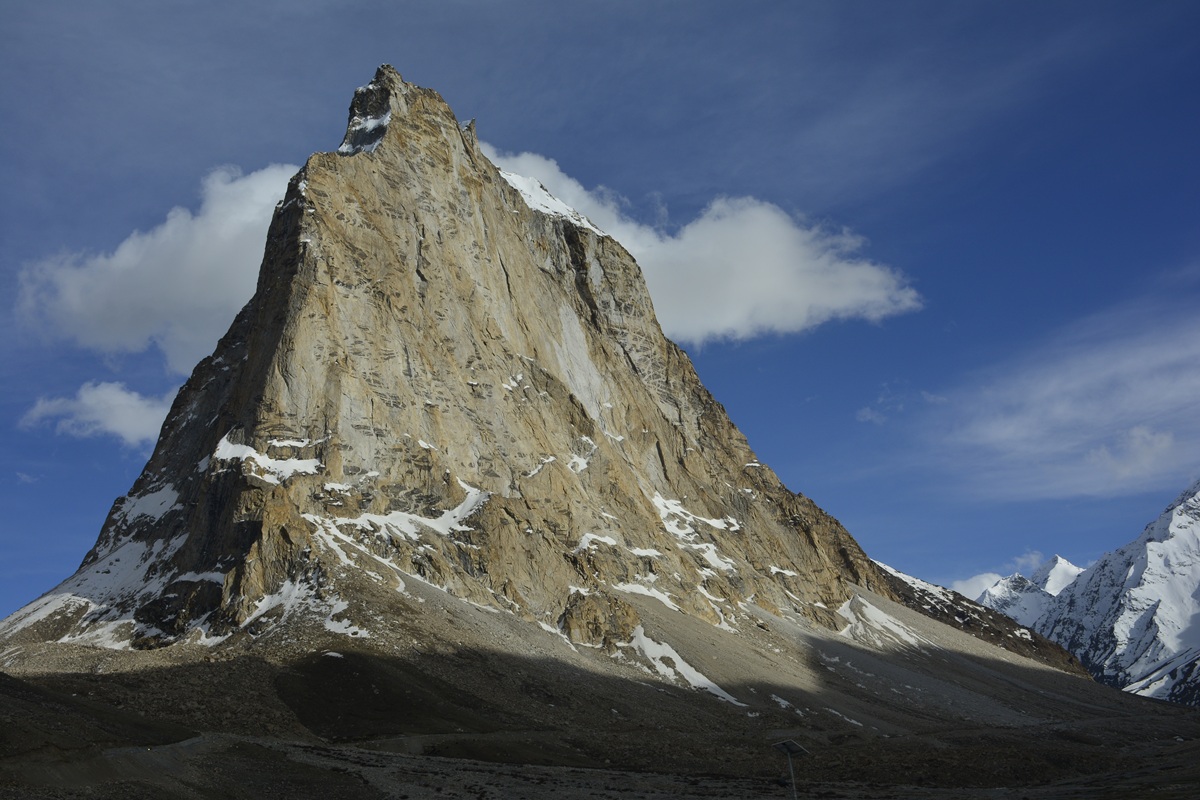
At first, it appeared far away, rising from the valley floor like an impossibly steep wall of rock. A few bends later, it appeared again. Larger this time. Then again. And again.
With every kilometre, it seemed to grow.
Photographs had prepared us for its existence. They had not prepared us for its scale.

It wasn’t difficult to understand why many people call Gombok Rangan the Matterhorn of India. The mountain did not blend into the landscape. It dominated it. The mountain wall rose almost vertically from the valley floor, towering above everything around it. No matter where we looked, our eyes eventually returned to it. The river, the road and the surrounding peaks all seemed secondary once Gombok Rangan entered the frame.
The first glimpse made us slow down.
The second made us gape at it.
The third convinced us that photographs would struggle to capture what stood before us.
There are mountains that become part of the scenery.
And then there are mountains that become the scenery.
It undoubtedly belonged to the second category.
Even as we continued towards Phuktal, the mountain remained with us. We kept turning around to look at it. We kept stopping to photograph it in rear view. Every bend in the road seemed to reveal a different version of the same mountain. It felt like a silent guardian watching over the entire valley.
And long before we reached Phuktal, it had already become one of the defining memories of the journey.

The Road to Phuktal Monastery
Gombok Rangan wasn’t our halt for the day.
Not yet.
We still had to reach Phuktal Monastery.

The road continued deeper into the valley towards Purne, following the river through a landscape that somehow kept becoming emptier. There were long stretches where we saw no vehicles, no villages and no signs of life apart from the river flowing beside us. The mountains rose steeply on either side, their slopes scarred by landslides, streams and changing weather.

Eventually, the road ended and the walk began.
The trail followed the river, crossed suspension bridges and wound its way through the valley. Every now and then we would stop, not because we were tired, but to capture the natural beauty in our camera. The river below was a strange shade of blue-green. The muddy cliffs seemed to rise straight out of the water. Looking around, it was difficult to imagine how anyone had ever built a monastery in a place like this.

As we walked, Phuktal remained hidden.
One bend.
Then another.
And another.
Nothing.
Then suddenly, it appeared.

Nobody had to announce it.
Nobody had to point.
We had all seen it in pics.
For a few seconds, we simply stood there.
After travelling all the way from Gurgaon, crossing Shinkula and driving through one of the remotest landscapes we had ever seen, the monastery was finally in front of us.
And somehow, it looked even more unbelievable than the photographs.

A Monastery Built into a Mountain
Built directly into a cliff face, Phuktal seemed less like a monastery and more like a part of the mountain itself. The weathered walls of the monastery emerged from the rock, prayer flags fluttered in the breeze and the river flowed far below in the valley. Even after seeing photographs over the years, the real thing felt difficult to believe.
The closer we got, the more questions came to mind. How had anyone built a monastery in a place like this? How had people lived here for centuries, surrounded by mountains and separated from the rest of the world by such difficult terrain? Looking at the monastery hanging from the cliff, it felt less like a structure and more like an extension of the mountain.

We spent some time wandering through the monastery, exploring its narrow passages and taking in the views from different corners. Monks moved quietly about their day. Nobody seemed in a hurry. The noise and urgency of everyday life felt very far away.
What stayed with me most was the sense of peace. Not the kind that comes from silence alone, but the kind that comes from being in a place that has remained unchanged for generations. Sitting there, looking across the valley and listening to the distant sound of the river, it was easy to understand why people make the effort to come here.
Eventually, it was time to leave. The shadows were beginning to lengthen across the valley and we still had to make our way back to Gombok Rangan before nightfall. As we started the walk back, I found myself turning around more than once for one last look at the monastery.

A Night at Minus Eight degC
By the time we reached Moksha Camp at Gombok Rangan, evening had arrived. The setting was spectacular. The giant rock spire towered above the valley. Snow-covered peaks surrounded the camp. A river flowed nearby.

As the sun disappeared, temperatures began dropping rapidly.
At first, it felt pleasant.
Then it felt cold.
Then it became serious.
By bedtime, I was wearing an a sweater, two jackets, two woollen caps, a muffler and two pairs of socks. Two quilts were piled on top of me.


That should have been enough.
It wasn’t.
The temperature eventually dropped to around minus eight degrees Celsius. The tent offered surprisingly little protection. Cold air leaked through tiny gaps in the fabric and every gust of wind seemed determined to remind us exactly where we were.
Every time I woke up, I adjusted a quilt, tightened the muffler or pulled a cap lower over my ears. For a few minutes things would improve. Then another wave of cold would arrive.
Sleep became a negotiation. The altitude wasn’t helping either. Every breath seemed to require a little more effort than usual.
Outside, the valley had fallen completely silent. The giant mountain stood somewhere in the darkness. The river continued flowing unseen. And the temperature continued falling, till it plummeted to -8 degC.
It was one of the coldest nights I have ever experienced in open.

Snowfall and a White Morning
Sometime during the night, snow began falling. We didn’t know it then. The mountains were quietly transforming the landscape while we struggled inside our tents.
The next morning delivered one of the most memorable sights of the trip. Sherpa stood covered in fresh snow. The surrounding mountains had turned white. The camp looked completely different from the evening before. What had been brown and grey now carried a fresh coating of snow.
Naturally, the next half hour was devoted to photography. Sherpa looked magnificent. The mountains looked even better.


And despite the brutal night, nobody seemed particularly unhappy. That is one of the strange things about travel. Discomfort often becomes a better memory than comfort.
From Silence to Kasol
The return journey took us back across Shinkula, through Keylong and eventually towards Kasol. Fresh snow from the previous night still lingered on sections of the pass and, at a few places, Sherpa’s tyres briefly lost grip before finding traction again. Nothing serious, but enough to remind us that mountain roads demand respect until the very end.

As the kilometres rolled by, the landscape slowly began changing once again. The barren mountains of Zanskar gave way to greener valleys, more vehicles appeared on the roads and mobile networks quietly returned to our phones. It felt as though we were gradually re-entering the world we had left behind a few days earlier.
The contrast became even more striking when we reached Kasol.


Less than twenty-four hours earlier, we had been standing in the silence of Gombok Rangan, surrounded by mountains and not much else. Kasol was the exact opposite. Cafés were busy, music drifted through the streets and travellers filled every corner of the town.
While looking for a hotel, we unexpectedly found ourselves in the middle of a disturbance. What began as an argument between tourists and locals over parking quickly escalated. Tempers flared, a fist fight broke out and, before anyone could fully comprehend what was happening, a tourist fired a pistol, injuring a local resident. Within minutes, a crowd had gathered and the police arrived at the scene. After spending the previous two days amidst the silence of Shinkula, Gombok Rangan and Phuktal, the violence came as a shock.
Kasol felt alive.
Literally alive.


That evening, sitting beside the river at a café, listening to the water rush past in the fading light, it was difficult to believe how much we had experienced in just a couple of days. Shinkula, Gombok Rangan, Phuktal, the snowfall, the bitter cold and now Kasol — it all felt like parts of a much longer journey.
Manikaran Sahib and the Road Home
The following morning, after an early darshan at Manikaran Sahib, we left around 8 AM and began the final leg of our journey home. The warmth of the hot springs and the peaceful atmosphere of the gurudwara felt like a fitting conclusion to a trip that had taken us through some of the most remote corners of the Himalayas.


The mountains, however, had one last lesson in patience for us.
Not far from Manikaran, traffic came to a complete standstill. What looked like a minor slowdown gradually turned into a long wait. Vehicles stretched endlessly ahead and behind us. Three hours later, we had covered barely enough distance to reach Bhuntar. After the empty roads of Zanskar, where we could drive for long stretches without seeing another vehicle, the traffic jam felt almost unreal.
Eventually the road began moving again and the journey continued. The mountains gradually gave way to towns, the roads became busier and phone notifications started finding their way back to us. One by one, the things we had left behind a few days earlier began returning.
By the evening of 31st May, Gurgaon had reappeared.
Traffic returned.
Deadlines returned.
Routine returned.
The trip was over.
But the memories of Shinkula, Gombok Rangan, Phuktal Monastery, the snowfall at Moksha Camp and three friends sharing a road through Zanskar were just beginning their journey into memory.
What Remains
A few years from now, I probably won’t remember every kilometre we drove. I won’t remember every tea stop, every fuel stop or every hotel room along the way.
But I know I will remember the Bhaga River racing beside us beyond Keylong. I will remember the stop before Shinkula where we paid our tribute to Haathi. I won’t forget standing on a pass that had remained beyond reach seven months earlier. The moment of the giant wall of Gombok Rangan appearing again and again through the valley, the first glimpse of Phuktal Monastery around a bend in the trail and the bitter cold of a night when sleep became a negotiation.


I will remember waking up to find Sherpa covered in fresh snow.
Most of all, I will remember three friends sharing a road for four days.
For a little while, there were no deadlines, no meetings and no routines. There was only the road ahead, mountains on every side and the freedom that comes from driving.
The trip lasted barely four days.
The memories will stay for a lifetime.

A mesmerising journey through the landscapes of Lahaul and being humbled by the sacred Gumbok Rangan Mountain. The whole journey showed that discipline and grit are the ways to move forward and the unknown will lay down the path by itself. Just moving on is what matters.
Absolutely Gaurav… Mountains humble us. They don’t adjust for us (mountain sickness, cold, snow, landslides etc), we adjust for the mountains.
What an incredible journey to Shinkula, Gombok Rangan, and Phuktal Monastery! The way you described every detail was truly captivating. As I read through it, I felt as if I was experiencing those four days right alongside you.
Our country is blessed with so many breathtaking places, and getting the chance to witness them through your own eyes must be an unforgettable experience. I wouldn’t consider myself much of a travel enthusiast, but after reading this, I genuinely feel inspired to visit such places someday
Thank you, Narinder. Your review & comment genuinely made my day. I’m delighted that the story made you feel part of the journey. Places like Shinkula, Gombok Rangan and Phuktal are truly unforgettable, and I’m glad I could bring a small part of that experience to you through this travelogue. Thank you so much for reading and for your kind words. 🙏
A journey filled with memories, laughter, and breathtaking views. Loved every bit of it!
Thank you so much Pramanshu. Without you and Sherpa, this journey wouldn’t have been completed. What an experience it was for us, especially while facing Gombok Rangan’s bitter cold… Absolutely brutal.