
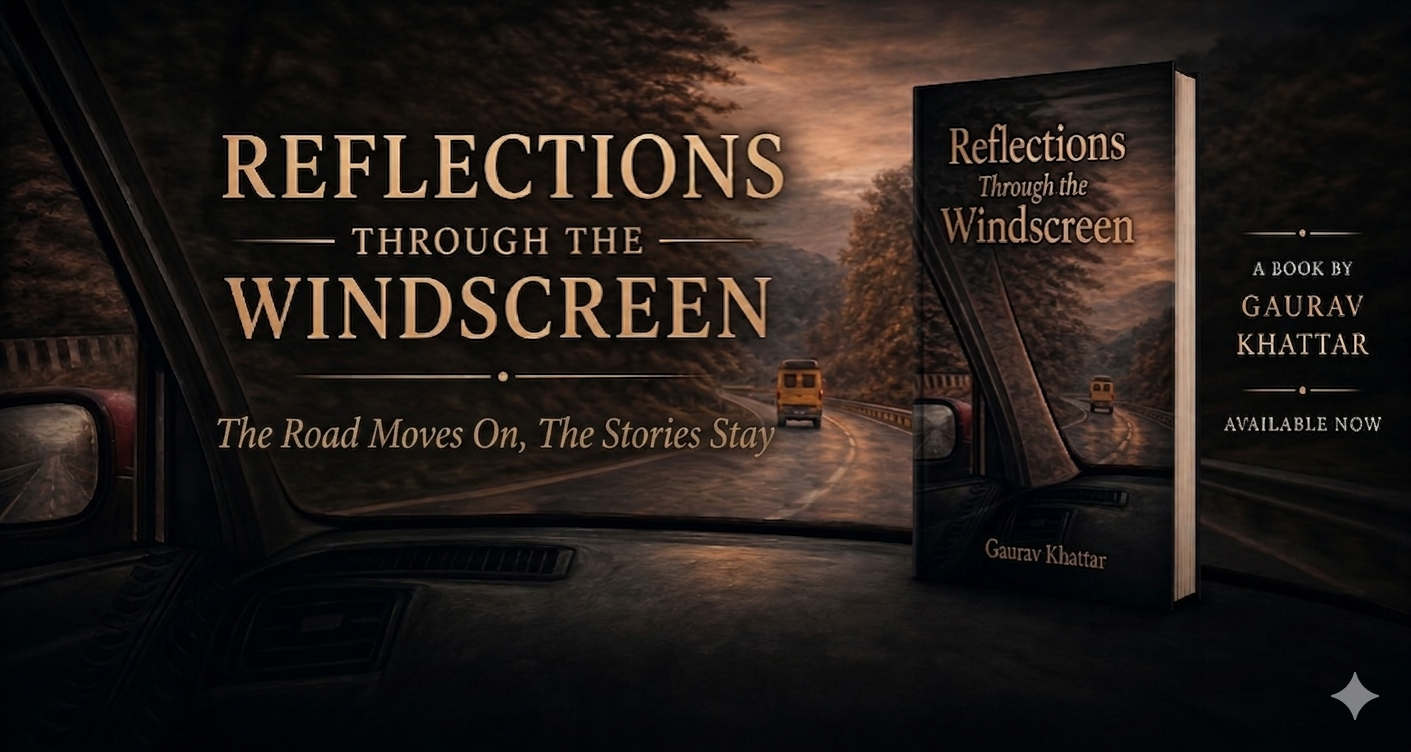
Reflections Through the Windscreen
Stories, memories, and reflections from the road.
What stayed with me from the road was rarely just the destination. It was the conversations, the silences, the people beside me, the thoughts that arrived uninvited, and the version of myself I seemed to meet most honestly behind the wheel. Reflections Through the Windscreen grew out of those journeys and the memories, questions, and quiet truths they left behind.

About the Book
Every drive begins the same way: a turn of the key and an engine that comes alive. But through the windscreen of a car, the road often reveals more than just the path ahead—it reflects the driver within.
Reflections Through the Windscreen is a quiet exploration of life as seen from behind the wheel—through highways, mountain roads, city traffic, and long, solitary drives.
Across nearly three decades of driving, the narrative traces an inner journey shaped as much by stillness as by movement. From fog-covered highways to silent red lights, these are moments frozen in time, revealing what usually goes unnoticed.
There are no loud conclusions here. Only a pause.
The road moves on.
The stories stay.

Book details
Title: Reflections Through the Windscreen
Author: Gaurav Khattar
Genre: Reflective Memoir
Paperback: 128 pages
ISBN-13: 978-9358126464
ISBN-10: 9358126469
Read an Excerpt…
Ignition
We had started early in the morning. The kind of morning when the city is still sleepy and the streets feel unusually empty. Gurgaon – Delhi drive along the National highway was buttery smooth with almost no traffic. Up to Ghaziabad, it was a perfect start to a road trip. For a while, everything was normal. Then the fog arrived.
……………………………………………………………………………………………………..
Every road trip starts with the turn of a key. Mine began that morning on the road to Mussoorie.
In fog, we don’t follow the road.
We follow belief.
Miles Between Conversations
That is when we realize this about long drives: the car is not just carrying people; it is holding conversations.
Some spoken.
Some unspoken.
And along the way, those conversations begin to matter more than the drive itself.
When Journeys Test Your Nerve
The way down demanded more than the climb.
It always does.
Twice, the foot slipped on slush. Nothing serious — just enough to remind.
And somewhere along that descent, it became clear — something the road had been teaching all along.
The mountain does not adjust for us.
We adjust for the mountain.
Machines Become Memories
For three long hours, Haathi descended through the dark mountains—through empty stretches of road and bends that demanded patience more than power—without complaint, without impatience, with no warning lights and no drama.
We rolled into Kullu around 9 PM on Dussehra night, when the town was glowing with the burning effigies of Ravana. That evening, it felt like our own small battle had been fought — and quietly won.
The Way We Park
That small, ordinary act—parking a car—subtly reveals more about a driver than the entire drive before it, because:
Driving is performance
But parking is personality.
Real Photographs Featured in the Book


Book Cover Inspiration
Every book has an origin story.
Mine began somewhere between Bangalore and Gurgaon, when I drove with my sister for almost 2500km in three days.
A random click during a road trip with my sister… Years later, it became the cover of Reflections Through the Windscreen.
Funny how the moments we don’t plan often leave the deepest marks.

About the Author
A car, Gaurav Khattar believes, is more than a machine — it’s a room that moves. A space for memory, introspection, and return.
Reflections Through the Windscreen is his debut book, a collection of stories gathered from roads travelled, conversations remembered, and the quiet truths that surface when you’re alone behind the wheel.
By profession, Gaurav is a chemical engineer with 25+ years of experience in global energy and refining projects. But much of his life has unfolded elsewhere — driving through mountains and cities, chasing stillness in ordinary moments.
An orophile (lover of mountains) at heart, he writes and photographs these journeys at vacationsnippets (vacationsnippets.in), where travel and everyday life are captured in simple, unhurried words.

Book Review – beyond my words…
A book truly begins its journey when it reaches its readers. Every reader experiences the same pages differently, discovering reflections shaped by their own memories, journeys, and moments in life. This collection of reviews brings together those unique perspectives—honest reflections, thoughtful observations, and personal takeaways from people who have travelled through Reflections Through the Windscreen.
Rather than telling you what to expect, these voices offer a glimpse of the many ways the book has been experienced. Perhaps, as you explore their thoughts, you’ll find yourself looking forward to discovering the reflections that await you in your own journey through its pages.
Articles on the book

Amazon Reviews and Messages


Book Launch Moments
📖 𝗥𝗲𝗳𝗹𝗲𝗰𝘁𝗶𝗼𝗻𝘀 𝗧𝗵𝗿𝗼𝘂𝗴𝗵 𝘁𝗵𝗲 𝗪𝗶𝗻𝗱𝘀𝗰𝗿𝗲𝗲𝗻 found its wings—not in the pages of a book, but in the voices of the people who came together to celebrate it.
✨ What began as a book launch at Quill & Canvas, turned into something far richer…
𝑨𝒏 𝑬𝒗𝒆𝒏𝒊𝒏𝒈 𝒐𝒇 𝑺𝒕𝒐𝒓𝒊𝒆𝒔.

When I wrote Reflections Through the Windscreen, I hoped it would encourage readers to pause and reflect on their own journeys.
💛 That hope came alive.
The launch became far more than the release of a book. It became an evening of shared stories, laughter, memories, and meaningful conversations. Friends, family, colleagues, and well-wishers didn’t just attend—they became a part of the story.


They spoke of road trips, the nicknames they had given their cars, unexpected detours, and small moments that had stayed with them for years. Every story added a new layer to the evening and reminded me that every journey carries reflections worth sharing.
The most moving part wasn’t watching people hold a copy of my book. It was watching them open up to one another—really listen, really connect.
That’s what made the evening unforgettable.


🙏 To everyone who showed up, shared a memory, and turned this launch into a real conversation—your time, your warmth, and your stories meant more than words can say. And to everyone who picked up a copy of Reflections Through the Windscreen, I’m humbled by the trust you’ve placed in my words. I hope you find a little of your own journey somewhere in these pages.
With a full heart, thank you. ❤️
𝗧𝗵𝗲 𝗥𝗼𝗮𝗱 𝗠𝗼𝘃𝗲𝘀 𝗢𝗻,
𝗧𝗵𝗲 𝗦𝘁𝗼𝗿𝗶𝗲𝘀 𝗦𝘁𝗮𝘆


Podcast
Roads connect places. Conversations connect people. Inspired by my book, Reflections Through the Windscreen, this podcast features meaningful conversations on travel, driving, books, life, and the experiences that quietly shape us.
It’s not just about where the road leads, but what the road reveals.

Celebrating at Work
Some memories never make it into the book. This is one of them. A conference room. A cake that looked like my book. The celebration carried everyone’s love. The day Reflections Through the Windscreen was published, my friends & colleagues turned an ordinary workday into a memory I’ll cherish forever. ❤️


Available in India at
Available Internationally
International Amazon Stores
Enjoyed the Book? I’d Love Your Review.
Thank you once again for reading Reflections Through the Windscreen. I’m grateful that you gave the book your time and attention.
You can share your review here:
Thank you for your support and encouragement. It truly means a lot.
The Road Moves On
The Stories Stay
Thank you for visiting. I hope these reflections inspire you to look at your own journeys a little differently.
…………………………………………………………………………………………………………………………………
See you on the road.